

Imagine that you are sitting in a chamber with your back to one wall. An electron beam, moving horizontally from back wall towards the front wall, is deflected by a strong magnetic field to your right side. What is the direction of magnetic field?
Solution:
Here , An electron beam, moving horizontally from back wall towards the front wall so, the direction of current will be in the opposite direction i.e. horizontally from front wall towards the back wall or towards us. The direction of the deflection of [EMF] is towards our right.
Let us use left hand Flemings rule: Adjust center finger point towards us (I) and thumb towards right side (EMF) then our forefinger will point in downward direction (MF)

Question:
A current through a horizontal power line flows in east to west direction. What is the direction of magnetic field at a point directly below it and at a point directly above it?
Solution
The current is in the east-west direction. Applying the right-hand thumb rule, we get that the direction of magnetic field at a point below the wire is from north to south. The direction of magnetic field at a point directly above the wire is from south to north
Question:
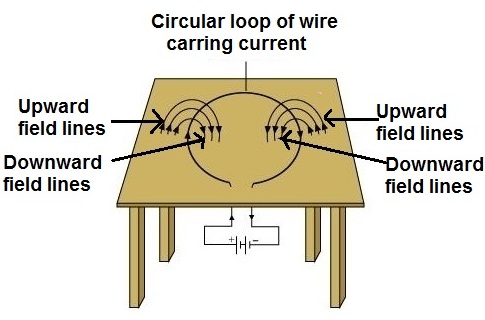
Consider a circular loop of wire lying in the plane of the table. Let the current pass through the loop clockwise. Apply the right-hand rule to find out the direction of the magnetic field inside and outside the loop.
Solution
In the following diagram the current is flowing clockwise. If we are applying right hand thumb rule to the left side of the loop then the direction of magnetic field lines inside the loop are going into the table while outside the loop they are coming out of the table. If we are applying right hand thumb rule to the right side of the loop then the direction of magnetic field lines inside the loop are again going into the table while outside the loop they are coming out of the table.
Question:
A positively-charged particle (alpha-particle) projected towards west is deflected towards north by a magnetic field. The direction of magnetic field is (a) towards south (b) towards east (c) downward (d) upward
Solution:
(d) Upward
Here, the positively-charged particle (alpha-particle) projected towards west, so the direction of current is towards west. The deflection is towards the north.
Let us use left hand Flemings rule: Adjust center finger towards west (I) and thumb towards north (EMF) then our forefinger will point in upward direction (MF)

Comments
Post a Comment